
ResearchSep 16, 2026
BallBOPPer™ 2026 Elevator Reveal
Elevation is a very important feature for any tennis training system. This is a reveal of the BallBOPPer elevation prototype as it currently appears in testing.
Looking at the overall design of the 2026 BallBOPPer, you would be right to think that the whole system has been redesigned around the catching and elevation features.
Why is elevation so important?
Most ball machines sit on the baseline of the opposite side of the court from the player and launch balls intended to be hit from around the baseline on the player's side of the court. This encourages and trains the player in baseline rallies, and nothing else.
The three most important shots in tennis are: the serve, the return of serve, and the return of the return of serve aka - the "plus one".
You can practice serving without a ball machine, but have you ever tried to use a standard ball machine to practice your return of serve?
Standard ball machines are unable to effectively launch serves because of the height that they launch from. You cannot launch a ball from a foot above the baseline as most ball machines do, have it pass over the 3-foot net, and then have the ball land in the service box at more than about 30 mph. It is not physically possible.
Needless to say, you cannot learn to return serves from a machine that can only launch serves at 30 mph.
And what about the return of the return of serve. A ball machine does not actually return anything - and therefore cannot help you there either.
In other words, standard ball machines cannot replicate actual tennis play first because they are stationary (which is why we built the Rover), second because they cannot return anything (which is why we are building the Catcher), and third, without some sort of clunky platform, they cannot launch from height (which is why we are now introducing the Elevator).
For effective tennis training a launching system must be able to launch at height - not only to replicate serves that land at high speed in the service box, but also to replicate ground strokes which are typically hit from around shoulder height.
The BallBOPPer Elevator is able to dynamically change the launch height with every launched ball and lower and raise itself for the catching of every returned ball, while the whole system roves the court at competitive player speeds.
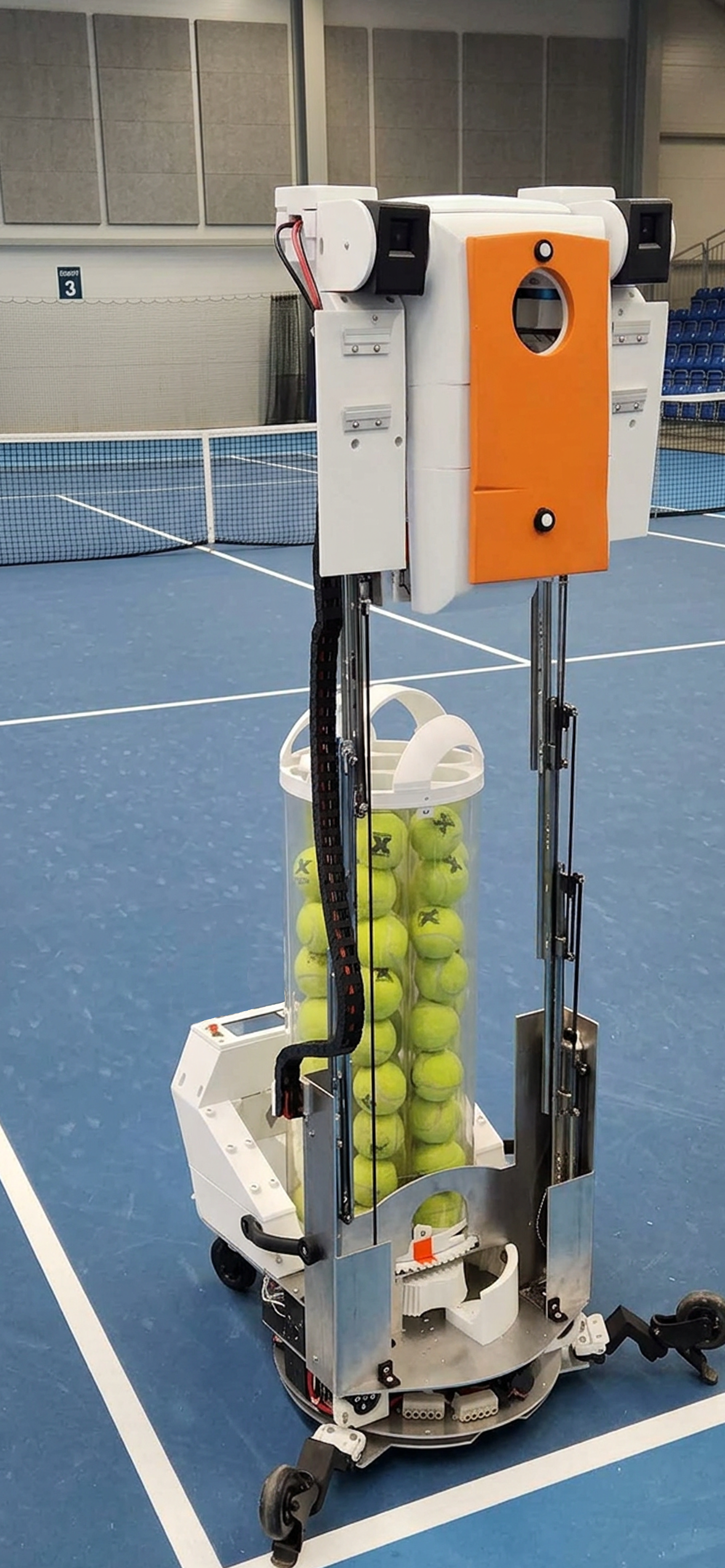
The prototype launcher system is shown above sitting on the court surface without the Rover underneath it.
The Elevator is optional like the Rover, Reloader and Catcher. The Launcher can be assembled and used without the Elevator, or the Elevator can be used with the Launcher without the Rover, or the Launcher, Elevator and Catcher can be mounted on the Rover to form the complete system.
The launch tower, which is the vertical aluminum frame on the front of the Launcher that supports the launch head, has two pieces that fit together like puzzle pieces and split when the Elevator is activated. The upper half is attached to the launch head, the lower half to the launch base and they are connected by the two elevation slide systems.
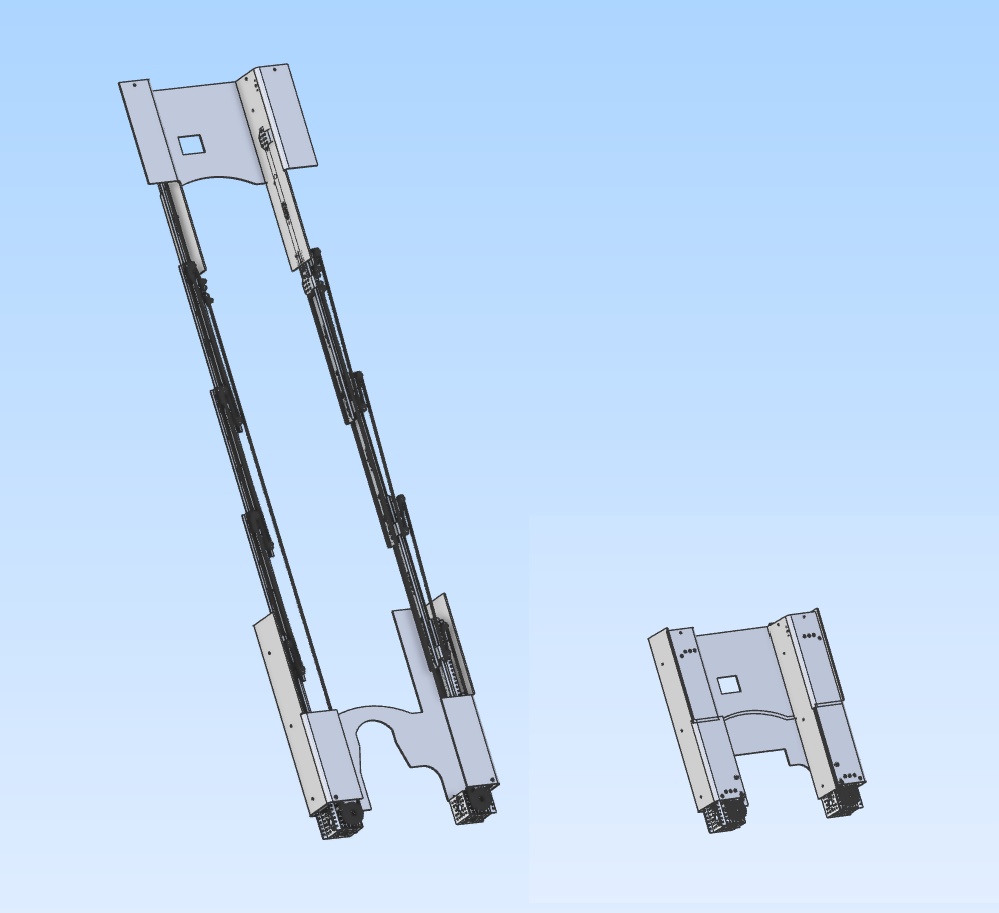
The Elevator is designed to elevate from court level to full height at high speed.
It generally does not stay at full height when moving but retracts to mid-height after launching each ball. Mid-height gives it the shortest distance to reach minimal or maximal retraction for the next catch and launch.
The launch head is designed to carry balls in the swirls mounted on the back of the launch head.
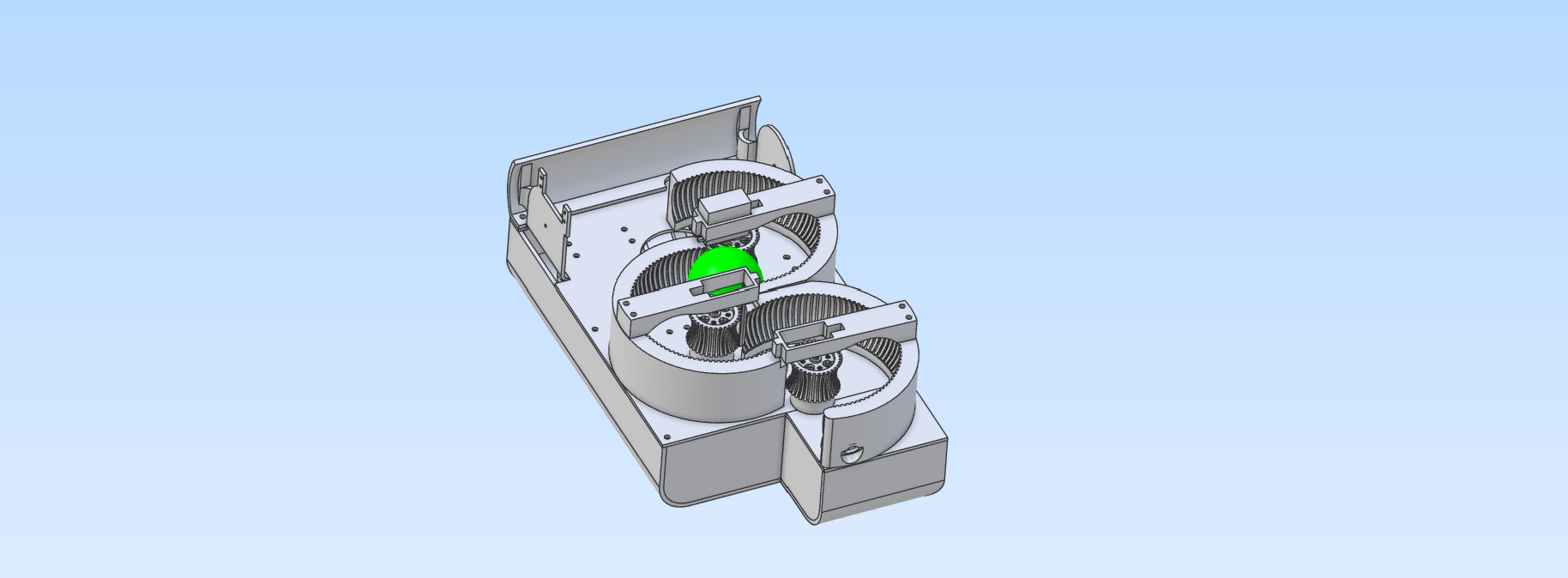
In this CAD drawing, only one ball is shown, but each swirl can hold 3 balls, and then 1 is also held in the launch position for a total of 10.
This allows the elevated launch head to participate in a 20-shot rally before needing to retract and reload from the Ball Revolver.
But with the Catcher attached (not shown), the BallBOPPer can rally for as long as it is able to catch each ball - allowing it to continue returning while elevated no matter how long the rally lasts.
The design goal of the Catcher is to catch every ball that is returned inside the lines. Of course, there will be "winners" that it cannot catch, and those, along with balls that land outside the lines, will then be auto reloaded between each game and set.
More information to come as testing proceeds.